“As a composer turned AI researcher who specializes in generative music technology, my long-term goal is to develop AI systems that can shed new light on how we understand, learn, and create music, and to learn from interactions between musicians in order to transform how we approach human-AI collaboration,” says Huang. “This new program will let us further investigate how musical applications can illuminate problems in understanding neural networks, for example.”
Sunday, September 29, 2024
09.27 - Anna Huang Assistant Professor @ MIT
Anna Huang, MuCoaCo alum, joins MIT's departments of Electrical Engineering and Computer Science and Music and Theater Arts as an assistant professor in September 2024 after eight years with Google Brain and DeepMind where she spearheaded efforts in generative modelling and reinforcement learning, and human-computer interaction in support of human-AI musical partnerships. Anna is creator of Music Transformer and Coconet, which powered the Bach Google Doodle. She holds a Canada CIFAR AI Chair at Mila. Anna holds a BM in music composition and BS in computer science from the University of Southern California, an SM from MIT, and a PhD from Harvard University.
At MIT, Anna is collaborating with Eran Egozy to devlop and launch MIT's new Music Technology and Computation Graduate Program at the intersection of music, computing, and technology. The program comprises of two two-semester master's degrees – a thesis-based Master of Science program available only to MIT undergraduates, and a coursework-based Master of Applied Science open to all students – and a PhD in MIT's School of Engineering.
Labels:
alumni
Friday, October 28, 2016
10.28 - Distributed Immersive Performance Videos Online

Over the years, these videos have been shown at numerous conferences and invited lectures. In response to requests for these videos, they have been shared online: documentation of the scientific experiments that led to the discovery that tolerance to network latency can be extended by enforcing a common clock, in this case, by delaying players' feedback from their own instruments to lineup with the signal arriving from their partner.
Setup A: Delays: vimeo.com/187646226
This video shows the increasing difficulty in synchronizing over increasing delays.
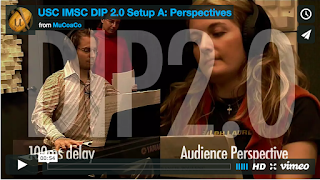
Setup A: Perspectives: vimeo.com/187647682
This video shows the difference in experience of delay from different perspectives.
Setup A: Commentaries: vimeo.com/189241592
This video shows the players commenting on the experience of playing with delay.
Setup B: vimeo.com/189272144
This video shows the solution we came up with---delaying each players' feedback from their own instrument.
Credits
Elaine Chew, experiment design and analysis
Alexandre R. J. François, software architecture
Christos Kyriakakis, spatial audio
Christos Papadopoulos, audio streaming
Alexander A. Sawchuk, project coordinator
Vely Stoyanova and Ilya Tosheff, performances
Roger Zimmerman, databases
Anja Volk, systematic musicological analysis
Carley Tanoue, performance data analysis
Dwipal Desai, databases
Moses Pawar, databases
Rishi Sinha, audio streaming
Will Meyer, filming and video editing
This material is based upon work supported by the National Science Foundation under grant no. 0321377 at the Integrated Media Systems Center, an NSF Engineering Research Center at the Viterbi School of Engineering, University of Southern California, Los Angeles, California, USA. nsf.gov/awardsearch/showAward?AWD_ID=0321377
Friday, September 9, 2016
09.09 - Isaac Schankler Assistant Professor @ Cal Poly Pomona
![]() |
| Isaac Schankler --> isaacschankler.com |
Congratulations, Isaac! A composer, accordionist, and electronic musician, Isaac's electronic-acoustic composition Pheremone has received glowing reviews on Fanfare Magazine, his generative game music techniques have been reviewed on Billboard and presented at GameSoundCon, and he is founder and artistic director of People Inside Electronics in Los Angeles. He is also an erudite writer of opinion pieces for NewMusicBox and was winner of 2013 was a winner of the ASCAP Deems Taylor Award for excellence in music journalism.
Photos of Cal Poly Pomona by Isaac Schankler:
Labels:
alumni,
compositions
Location:
Poly Vista, Pomona, CA, USA
Monday, August 1, 2016
08.01 - Ching-Hua Chuan promoted to Associate Professor @ UNF
Ching-Hua Chuan, an alumnus of the Music Computation and Cognition Laboratory at the University of Southern California, has received tenure and been promoted to Associate Professor in the School of Computing at the University of North Florida. As in most institutions in the United States, academics on tenure track in computer science (and most engineering fields) are hired as assistant professors without tenure (in a probationary period), and are evaluated after five years for promotion to associate professor with tenure in the sixth year in a highly competitive process. Congratulations, Ching-Hua!
Read more about Ching-Hua's work at www.unf.edu/~c.chuan.
Labels:
alumni
Location:
1 UNF Dr, Jacksonville, FL 32224, USA
Friday, September 26, 2014
09.26 - Academic Minute Features MuCoaCo Alum Ching-Hua Chuan
MuCoaCo alum, Ching-Hua Chuan, Assistant Professor of Computing at the University of North Florida speaks on Composing with Computers on The Academic Minute with Lynn Pasquerella, President of Mount Holyoke College. The Academic Minute features a different professor each day, giving anecdotes and updates on groundbreaking scientific research.
Ching-Hua Chuan's segment aired today on WAMC Public Radio in New York and on more than 60 radio stations across the United States. Hear it at:
academicminute.org/2014/09/ching-hua-chuan-university-of-north-florida-composing-with-computers
Ching-Hua Chuan's segment aired today on WAMC Public Radio in New York and on more than 60 radio stations across the United States. Hear it at:
academicminute.org/2014/09/ching-hua-chuan-university-of-north-florida-composing-with-computers
Labels:
alumni,
audio,
highlights,
press,
radio
Location:
New York, NY, USA
Saturday, April 26, 2014
04.26 - Digital Da Vinci Book Chapter on Mimi
Schankler, Isaac, Elaine Chew, and Alexandre R. J. Francois. (2014). Improvising with Digital Auto-scaffolding: How Mimi changes and enhances the creative process. In Newton Lee (ed.): Digital Da Vinci—Computers in Music, 99-125, Springer. ISBN 978-1-4939-0535-5. DOI: 10.1007/978-1-4939-0536-2_5.Access Options
| Individual chapter: SpringerLink Hardcover book: Amazon.com Amazon.co.uk |
Abstract: This chapter poses, and proposes some answers to, questions about the origins and nature of creativity when digital media takes an active role in the music-making process. The discussions are centered on François’ Mimi (Multimodal Interaction for Musical Improvisation) system, which enables a musician to seed the computer with musical ideas and then improvise atop re-combinations of these ideas; the system provides the musician with visual foreknowledge of the machine’s intent and review of the interaction. They extend to the different instantiations of, and extensions to, the Mimi system, which are designed with various interaction nuances in mind, and engender new forms of creativity. We review each Mimi version, from the original blue-and-white silhouette display, to the Scriabin-inspired varicolored panels, to the multi-paneled user-directed Mimi4x. In each scenario, we consider the impact of Mimi on the creative process and the resulting performance; specifically, we describe the interaction between a performer, the composer (when this is different from the performer), and the system, analyzing the techniques used to successfully negotiate a performance with Mimi, and the formal musical structures that result from this interaction.
Supplemental material (video):
![]() |
| Analysis of performance with Schankler and Mimi. |
Labels:
alumni,
publications
Wednesday, April 2, 2014
04.02 - MuCoaCo alum Ching-Hua Chuan discusses style identification in pop/rock music
To hear the interview, visit the UNF On The Record radio show's streaming site at www.unf.edu/publicrelations/media_relations/news/radio/2014/Style_identification_in_pop_and_rock_music.aspx
To learn more about Ching-Hua's work, visit her website at www.unf.edu/~c.chuan/Site/Home.html
Subscribe to:
Posts (Atom)