Quick Links

Wednesday, June 11, 2025

06.11 - Alex François wins ICMC Best Paper Award

Alex François who created the MuSA.RT and MIMI software, and whose software architecture style powered the ESP application, wins the Best Paper Award at the 50th International Computer Conference in Boston, Massachusetts, for his paper, "Resonate: Efficient Low Latency Spectral Analysis of Audio Signal".

Alexandre R.J. François’ research focuses on the modeling and design of interactive (software) systems, as an enabling step towards the understanding of perception and cognition. His interdisciplinary research projects explore interactions within and across music, vision, visualization and video games. He was a 2007-2008 Fellow of the Radcliffe Institute for Advanced Study at Harvard University, where he co-lead a music research cluster on Analytical Listening Through Interactive Visualization.

From 2004 to 2010, François was a Research Assistant Professor of Computer Science in the USC Viterbi School of Engineering at the University of Southern California. In 2010, he was a Visiting Associate Professor of Computer Science at Harvey Mudd College. In 2008-2009, he was a Visiting Assistant Professor in the Department of Computer Science at Tufts University. From 2001 to 2004 he was a Research Associate with the Integrated Media Systems Center and with the Institute for Robotics and Intelligent Systems, both at USC.

François received the Diplôme d’Ingénieur from the Institut National Agronomique Paris-Grignon (France) in 1993, the Diplôme d’Etudes Approfondies (M.S.) from the University Paris IX – Dauphine (France) in 1994, and the M.S. and Ph.D. degrees in Computer Science from USC in 1997 and 2000 respectively.

Resonate: Efficient Low Latency Spectral Analysis of Audio Signal

Abstract:This paper describes Resonate, an original low latency, low memory footprint, and low computational cost algorithm to evaluate perceptually relevant spectral information from audio signals. The fundamental building block is a resonator model that accumulates the signal contribution around its resonant frequency in the time domain, using the Exponentially Weighted Moving Average (EWMA).A compact, iterative formulation of the model affords computing an update at each signal input sample, requiring no buffering and involving only a handful of arithmetic operations. Consistently with on-line perceptual signal analysis, the EWMA gives more weight to recent input values, whereas the contributions of older values decay exponentially. A single parameter governs the dynamics of the system. Banks of such resonators, independently tuned to geometrically spaced resonant frequencies allow to compute an instantaneous, perceptually relevant estimate of the spectral content of an input signal in real-time. Both memory and per-sample computational complexity of such a bank are linear in the number of resonators, and independent of the number of input samples processed, or duration of processed signal. Furthermore, since the resonators are independent, there is no constraint on the tuning of their resonant frequencies or time constants, and all per sample computations can be parallelized across resonators. The cumulative computational cost for a given duration increases linearly with the number of input samples processed. The low latency afforded by Resonate opens the door to real-time music and speech applications that are out of the reach of FFT-based methods. The efficiency of the approach could reduce computational costs and inspire new designs for low-level audio processing layers in machine learning systems.

Monday, June 9, 2025

06.09 - Anna Huang gives ICMC Keynote

Anna Huang is a keynote speaker at the 50th International Computer Music Conference held in Boston, Massachusetts, from 8-14 June 2025.

“Algorithms and Interaction for Human AI Creative Partnerships”

Monday, June 9, 3:30pm – 4:30pm
Blackman Auditorium, Northeastern University

Cheng-Zhi Anna Huang 黃成之
Assistant Professor of Music
Assistant Professor of Electrical Engineering and Computer Science
Music and Theater Arts
School of Humanities, Arts and Social Sciences
Massachusetts Institute of Technology

In Fall 2024, Cheng-Zhi Anna Huang 黃成之 started a faculty position at Massachusetts Institute of Technology (MIT), with a shared position between Electrical Engineering and Computer Science (EECS) and Music and Theater Arts (MTA). For the past 8 years, she has been a researcher at Magenta in Google Brain and then Google DeepMind, working on generative models and interfaces to support human-AI partnerships in music making.

Anna Huang is the creator of the Machine Learning (ML) model Coconet that powered Google’s first AI Doodle, the Bach Doodle. In two days, Coconet harmonized 55 million melodies from users around the world. In 2018, she created Music Transformer, a breakthrough in generating music with long-term structure, and the first successful adaptation of the transformer architecture to music. Huang’s International Conference on Learning Representations (ICLR) paper is currently the most cited paper in music generation.

Anna Huang was a Canadian Institute for Advanced Research (CIFAR) AI Chair at Mila (Montreal Institute for Learning Algorithms, now Mila Quebec AI Institute), and continues to hold an adjunct professorship at the University of Montreal. Huang was a judge then organizer for the AI Song Contest 2020-22. She did her PhD at Harvard University, master’s at the MIT Media Lab, and a dual bachelor’s at the University of Southern California in music composition and CS.

Sunday, September 29, 2024

09.27 - Anna Huang Assistant Professor @ MIT

Anna Huang, MuCoaCo alum, joins MIT's departments of Electrical Engineering and Computer Science and Music and Theater Arts as an assistant professor in September 2024 after eight years with Google Brain and DeepMind where she spearheaded efforts in generative modelling and reinforcement learning, and human-computer interaction in support of human-AI musical partnerships. Anna is creator of Music Transformer and Coconet, which powered the Bach Google Doodle. She holds a Canada CIFAR AI Chair at Mila. Anna holds a BM in music composition and BS in computer science from the University of Southern California, an SM from MIT, and a PhD from Harvard University.
At MIT, Anna is collaborating with Eran Egozy to devlop and launch MIT's new Music Technology and Computation Graduate Program at the intersection of music, computing, and technology. The program comprises of two two-semester master's degrees – a thesis-based Master of Science program available only to MIT undergraduates, and a coursework-based Master of Applied Science open to all students – and a PhD in MIT's School of Engineering.
“As a composer turned AI researcher who specializes in generative music technology, my long-term goal is to develop AI systems that can shed new light on how we understand, learn, and create music, and to learn from interactions between musicians in order to transform how we approach human-AI collaboration,” says Huang. “This new program will let us further investigate how musical applications can illuminate problems in understanding neural networks, for example.”

Friday, October 28, 2016

10.28 - Distributed Immersive Performance Videos Online

Years ago, at the Integrated Media Systems Center at the University of Southern California, we embarked on a series of Distributed Immersive Performance experiments to determine the effect of network latency on ensemble performance. Building on earlier experiments, these were the first of their kind to use rhythmic and fast classical chamber music to test the limits of collaborative performance over the Internet.  The results and findings were reported in numerous publications including ACM TOMM and proceedings of ACM MM, AES, NASM, and CENIC.

Over the years, these videos have been shown at numerous conferences and invited lectures. In response to requests for these videos, they have been shared online: documentation of the scientific experiments that led to the discovery that tolerance to network latency can be extended by enforcing a common clock, in this case, by delaying players' feedback from their own instruments to lineup with the signal arriving from their partner.


Setup A: Delays: vimeo.com/187646226
This video shows the increasing difficulty in synchronizing over increasing delays.


Setup A: Perspectives: vimeo.com/187647682
This video shows the difference in experience of delay from different perspectives.


Setup A: Commentaries: vimeo.com/189241592
This video shows the players commenting on the experience of playing with delay.


Setup B: vimeo.com/189272144
This video shows the solution we came up with---delaying each players' feedback from their own instrument.


Credits

Elaine Chew, experiment design and analysis
Alexandre R. J. François, software architecture
Christos Kyriakakis, spatial audio
Christos Papadopoulos, audio streaming
Alexander A. Sawchuk, project coordinator
Vely Stoyanova and Ilya Tosheff, performances
Roger Zimmerman, databases

Anja Volk, systematic musicological analysis

Carley Tanoue, performance data analysis
Dwipal Desai, databases
Moses Pawar, databases
Rishi Sinha, audio streaming
Will Meyer, filming and video editing

This material is based upon work supported by the National Science Foundation under grant no. 0321377 at the Integrated Media Systems Center, an NSF Engineering Research Center at the Viterbi School of Engineering, University of Southern California, Los Angeles, California, USA. nsf.gov/awardsearch/showAward?AWD_ID=0321377

Friday, September 9, 2016

09.09 - Isaac Schankler Assistant Professor @ Cal Poly Pomona

Isaac Schankler --> isaacschankler.com
Isaac Schankler, affiliated artist / postdoctoral research affiliate at the Music Computation and Cognition Lab at the University of Southern California (USC), and visiting scholar at the Music Performance and Expression Lab at QMUL's Centre for Digital Music (C4DM) has accepted a position as Assistant Professor of Music Industry Studies at Cal Poly Pomona in California, USA.

Congratulations, Isaac!  A composer, accordionist, and electronic musician, Isaac's electronic-acoustic composition Pheremone has received glowing reviews on Fanfare Magazine, his generative game music techniques have been reviewed on Billboard and presented at GameSoundCon, and he is founder and artistic director of People Inside Electronics in Los Angeles.  He is also an erudite writer of opinion pieces for NewMusicBox and was winner of 2013 was a winner of the ASCAP Deems Taylor Award for excellence in music journalism.

Photos of Cal Poly Pomona by Isaac Schankler:


Monday, August 1, 2016

08.01 - Ching-Hua Chuan promoted to Associate Professor @ UNF


Ching-Hua Chuanan alumnus of the Music Computation and Cognition Laboratory at the University of Southern California, has received tenure and been promoted to Associate Professor in the School of Computing at the University of North Florida. As in most institutions in the United States, academics on tenure track in computer science (and most engineering fields) are hired as assistant professors without tenure (in a probationary period), and are evaluated after five years for promotion to associate professor with tenure in the sixth year in a highly competitive process.  Congratulations, Ching-Hua!

Ching-Hua is received her PhD from the Department of Computer Science at USC, where she received a Digital Dissertation Award and was elected to Phi Kappa Phi honor society. Her research interests center on artificial intelligence and machine learning, and her projects range from style-specific music harmonization to sign language recognition. She is recipient of a Grace Hopper Celebration Best New Investigator Paper Award, and her work has been featured on Foxnews, MSNBC, the Telegraph, the Miami Herald, and the IEEE Intelligent Systems Magazine. A innovative educator, she is also recipient of UNF's Outstanding Undergraduate Teaching Award and has developed new courses on music informatics and on gaming and mobile app development.

Read more about Ching-Hua's work at www.unf.edu/~c.chuan.


Friday, September 26, 2014

09.26 - Academic Minute Features MuCoaCo Alum Ching-Hua Chuan

MuCoaCo alum, Ching-Hua Chuan, Assistant Professor of Computing at the University of North Florida speaks on Composing with Computers on The Academic Minute with Lynn Pasquerella, President of Mount Holyoke College.  The Academic Minute features a different professor each day, giving anecdotes and updates on groundbreaking scientific research.

Ching-Hua Chuan's segment aired today on WAMC Public Radio in New York and on more than 60 radio stations across the United States.  Hear it at:
academicminute.org/2014/09/ching-hua-chuan-university-of-north-florida-composing-with-computers

Saturday, April 26, 2014

04.26 - Digital Da Vinci Book Chapter on Mimi

Schankler, Isaac, Elaine Chew, and Alexandre R. J. Francois. (2014). Improvising with Digital Auto-scaffolding: How Mimi changes and enhances the creative process. In Newton Lee (ed.): Digital Da Vinci—Computers in Music, 99-125, Springer. ISBN 978-1-4939-0535-5. DOI: 10.1007/978-1-4939-0536-2_5.


Access Options


Individual chapter:
SpringerLink

Hardcover book:
Amazon.com
Amazon.co.uk                                                            


Abstract: This chapter poses, and proposes some answers to, questions about the origins and nature of creativity when digital media takes an active role in the music-making process. The discussions are centered on François’ Mimi (Multimodal Interaction for Musical Improvisation) system, which enables a musician to seed the computer with musical ideas and then improvise atop re-combinations of these ideas; the system provides the musician with visual foreknowledge of the machine’s intent and review of the interaction. They extend to the different instantiations of, and extensions to, the Mimi system, which are designed with various interaction nuances in mind, and engender new forms of creativity. We review each Mimi version, from the original blue-and-white silhouette display, to the Scriabin-inspired varicolored panels, to the multi-paneled user-directed Mimi4x. In each scenario, we consider the impact of Mimi on the creative process and the resulting performance; specifically, we describe the interaction between a performer, the composer (when this is different from the performer), and the system, analyzing the techniques used to successfully negotiate a performance with Mimi, and the formal musical structures that result from this interaction.


Supplemental material (video):


Analysis of performance with Schankler and Mimi.

Wednesday, April 2, 2014

04.02 - MuCoaCo alum Ching-Hua Chuan discusses style identification in pop/rock music

ching-hua chuan

MuCoaCo alum Ching-Hua Chuan, now an Assistant Professor of Computing at the University of North Florida, discusses her research on a identifying style in pop/rock music through a multi-modal approach on “UNF On The Record,” a weekly radio show featuring campus life topics and faculty and student research.

To hear the interview, visit the UNF On The Record radio show's streaming site at www.unf.edu/publicrelations/media_relations/news/radio/2014/Style_identification_in_pop_and_rock_music.aspx

To learn more about Ching-Hua's work, visit her website at www.unf.edu/~c.chuan/Site/Home.html

Saturday, March 15, 2014

03.15 - Isaac Schankler & co.'s Depression Quest is XYZZY Interactive Fiction Awards Best Implementation Finalist


Depression Quest, an award-winning interactive (non)fiction game about living with depression by Zoe Quinn, Patrick Lindsey, and Isaac Schankler, designed to spread awareness about depression, is a Best Implementation finalist for the 2013 XYZZY Awards, the equivalent of Academy or Grammy Awards recognizing extraordinary interactive fiction.

For Depression Quest, Isaac Schankler designed a generative and interactive soundtrack that depends on the player's path through the game. The music includes samples from freesound.org and is inspired by Arvo Pärt, Ryuichi Sakamoto, Alva Noto, David Kanaga.  Click on the square to download Isaac Schankler's soundtrack.

Isaac Schankler is an alum of both the QMUL Music Performance and Expression mini-group at the Centre for Digital Music (visiting artist-in-residence in 2012) and of the USC Music Computation and Cognition Lab (2010-2012), working on and improvising with both Mimi and Mimi4x.

Thursday, October 3, 2013

10.03 - Isaac Schankler wins ASCAP Foundation Deems Taylor Award

Isaac Schankler, visiting artist-in-residence 2011-2012, wins an ASCAP Foundation Deems Taylor Award for his article “Sounds Heard: Anatomy of a Truth-Bender” on Adele and musical expression, published by New Music Box/New Music USA.

From the press release
The Awards were established in 1967 to honor the memory of composer, critic and commentator Deems Taylor, who died in 1966 after a distinguished career that included six years as President of ASCAP. The 45th ASCAP Foundation Deems Taylor Awards are made possible by the generous support of ASCAP, The ASCAP Foundation and the Virgil Thomson Foundation. Virgil Thomson (1896-1989) was one of the great 20th century composers and music critics. Thomson served as a member of ASCAP's Board of Directors from 1975 to 1982.

The winners of the 45th annual ASCAP Foundation Deems Taylor Awards ... will be honored at a special invitation-only ceremony and reception on Thursday, November 14th at ASCAP's New York offices.

Friday, October 12, 2012

10.08-12 - MuCoaCo Alumni @ ISMIR

Three MuCoaCo alumni - Ching-Hua Chuan, Erdem Unal, and ChangHyun (Daniel) Kim - and two current PhD students - Jordan Smith and Katerina Kosta - attended ISMIR in Porto, Portugal, this year.  The posters presented were as follows:

Chuan, C. & Chew, E. (2012). Creating Ground Truth for Audio Key Finding: When the Title Key May Not Be the Key. [ pdf ]

Kosta, K., Marchini, M. & Purwins, H. (2012). Unsupervised Chord-Sequence Generation from an Audio Example [ pdf ]

Unal, E., Bozkurt, B. & Karaosmanoğlu, M. (2012). N-gram Based Statistical Makam Detection on Makam Music in Turkey Using Symbolic Data [ pdf ]


Ching-Hua Chuan is founder of the WiMIR (Women in Music Information Retrieval) special interest group that met a second time in a row at ISMIR.

Daniel Kim, currently a PhD candidate at KAIST, participated in the audio onset detection MIREX competition.


Tuesday, February 28, 2012

02.28 - New Music Box publishes article by Isaac Schankler

Sounds Heard: Anatomy of a Truth-Bender
February 28, 2012 / By

Sounds Heard: Anatomy of a Truth-BenderIt’s easy to understand the appeal of an article like the Wall Street Journal‘s “Anatomy of a Tear-Jerker,” which purports to explain why Adele’s hit song “Someone Like You” makes people cry. Unfortunately, the article is marred by a number of scientific, musical, and aesthetic misconceptions, some glaring and some more subtle.

Saturday, February 25, 2012

02.25 - VRME Bamberger tribute issue now available

Creativity SRIG sponsored Jeanne Bamberger tribute issue of VRME now available.  Message from the editors, S. Alex Ruthman and Gena R. Greher:

At the 2010 meeting of the Creativity SRIG, we were treated to a keynote presentation by eminent music cognition scholar Jeanne Bamberger. For over 40 years, her research and scholarship in the fields of music cognition, music learning, intuition and creativity has had, and continues to have, a profound international impact within and beyond music-related fields.

After her presentation, the Creativity SRIG announced a call for submissions to a special tribute issue of Visions of Research in Music Education (VRME) in honor of Jeanne’s work and career. We are thrilled to announce the publication of that tribute issue as Volume 20  of Visions of Research in Music Education .
:
This special issue of VRME contains 12 feature articles and essays with authors hailing from Australia, Germany, Israel, the UK and the US:

Editorial
Gena R. Greher & Alex Ruthmann - Curiosity, Creativity and Cognition: A Window into Jeanne Bamberger’s Work.

Featured Articles
Howard Gardner - Tribute to Jeanne Bamberger: Pre-eminent Student of Musical Development and Cognition in Our Time.
Gena R. Greher & S. Alex Ruthmann - On Chunking, Simples and Paradoxes: Why Jeanne Bamberger’s Research Matters.
Andrew Brown - Experience Design and Interactive Software in Music Education Research.
Kimberley Lansinger Ankney - Building and Composing upon Musical Knowledge.
Michael P. Downton, Kylie A. Peppler, Adena Portowitz, Jeanne Bamberger, & Eric Lindsay - Composing Pieces for Peace: Using Impromptu to Build Cross-Cultural Awareness.
Jessica Krash - Reminiscence on Studying with Jeanne Bamberger.
Joyce Kouffman - Jeanne Bamberger - Vignettes from 1974-1976.
Wilfred Gruhn - Representations of Music - Neural Foundations and Mental Processes.
Craig Graci - Channeling Bamberger: An Unorthodox Appreciation of Jeanne Bamberger’s work on Musical Development and Musical Understanding.
Elaine Chew - About Time: Strategies of Performance Revealed in Graphs.
Christopher F. Hasty - Learning in Time.
Deborah V. Blair - Do you hear what I hear? Musical Maps and Felt Pathways of Musical Understanding. (a reprint from VRME Volume 11)

Historical Reprint:
Jeanne Bamberger - Developing Musical Structures: Going Beyond the Simples.

Access to these articles and essays may be found at http:www-usr.rider.edu/~vrme .

Tuesday, January 17, 2012

01.17 - UCSB and the Allosphere

Elaine Chew is invited to give an MAT (Media Arts and Technology) seminar on Building Bridges: Creating Sustainable Collaborations Amongst Musicians and Engineers [video] at the University of California, Santa Barbara.


She gets a tour of the Allosphere with JoAnn Kuchera-Morin; and catches up with Curtis Roads and Stephen Pope at dinner.


Her visit is organized by Șӧlen K. DiCicco.

Tuesday, January 10, 2012

01.10 - IPAM Largescale Multimedia Search Workshop

Elaine Chew is an invited speaker at a Institute for Pure and Applied Mathematics (IPAM) Largescale Multimedia Search Workshop that takes place January 9-13 at the University of California, Los Angeles. She represents the Music Information Retrieval community with Juan Bello, Laurent Daudet, and Malcolm Slaney, and gives a talk on Music Structure and Prosody.

Friday, June 17, 2011

06.17 - Intl Conf on Mathematics & Computation in Music @ Ircam

Members of MuCoaCo attended the MCM (Mathematics and Computation in Music) meeting held at Ircam (Institut de Recherche et Coordination Acoustique/Musique) this week.


MuCoaCo alum, Anja Volk, and Aline Honingh co-hosted a panel on "Bridging the Gap: Computational and Mathematical Approaches in Music Research."


On the first evening was a dialog with Pierre Boulez and Alain Connes coordinated by Gérard Assayag at Ircam's Espace de Projection.


We had a group picture with Gérard in the Ircam corridor. From left to right: Isaac Schankler, Anna Huang, Gérard Assayag, Anja Volk, Elaine Chew, Jordan Smith, Aline Honingh.


Isaac and Jordan presented a paper on "Emergent Formal Structures of Factor Oracle-Driven Musical Improvisations" and Isaac gave a demonstration of Mimi on the final day of the conference.  The paper is described in this earlier post.

Sunday, May 22, 2011

05.22 - Light and Power reviews

Isaac Schankler's chamber opera, Light and Power, was recently reviewed in Miss Music Nerd and the Boston Musical-Intelligencer, which wrote:

Schankler’s music is extraordinarily eclectic--where traditional operatic roles may have themes or motifs associated with characters, Schankler attached entire musical idioms to them... All of the music was masterfully composed.


Congratulations to all the performers and crew!

Tuesday, May 17, 2011

05.19 - Light & Power!

The Juventas New Music Ensemble premieres Isaac Schankler's opera, Light & Power, billed as "a Nikola Tesla World Premiere Opera" and "a Tesla/Edison story" (libretto by Jillian Burcar), in Cambridge, Massachusetts.

The Cambridge YMCA Theater
820  Massachusetts Ave
Cambridge, MA 02139

Thu, May 19, at 8 pm | Fri, May 20, at 8 pm
Sat, May 21, at 8 pm | Sun, May 22, at 2 pm

More details here.

Friday, April 29, 2011

04.29 - Ge Wang Visit (Pictures)

Ge Wang's visit to USC began with the Structure In Music (ISE575/EE675/CSCI575) class, where he chimed in on Huihui Cheng's presentation of a paper on his iPhone Ocarina app, and Samir Sharma's presentation of a paper on the Stanford Laptop Orchestra (SLOrK), and gave numerous insights into the development of both the Ocarina and SLOrK.
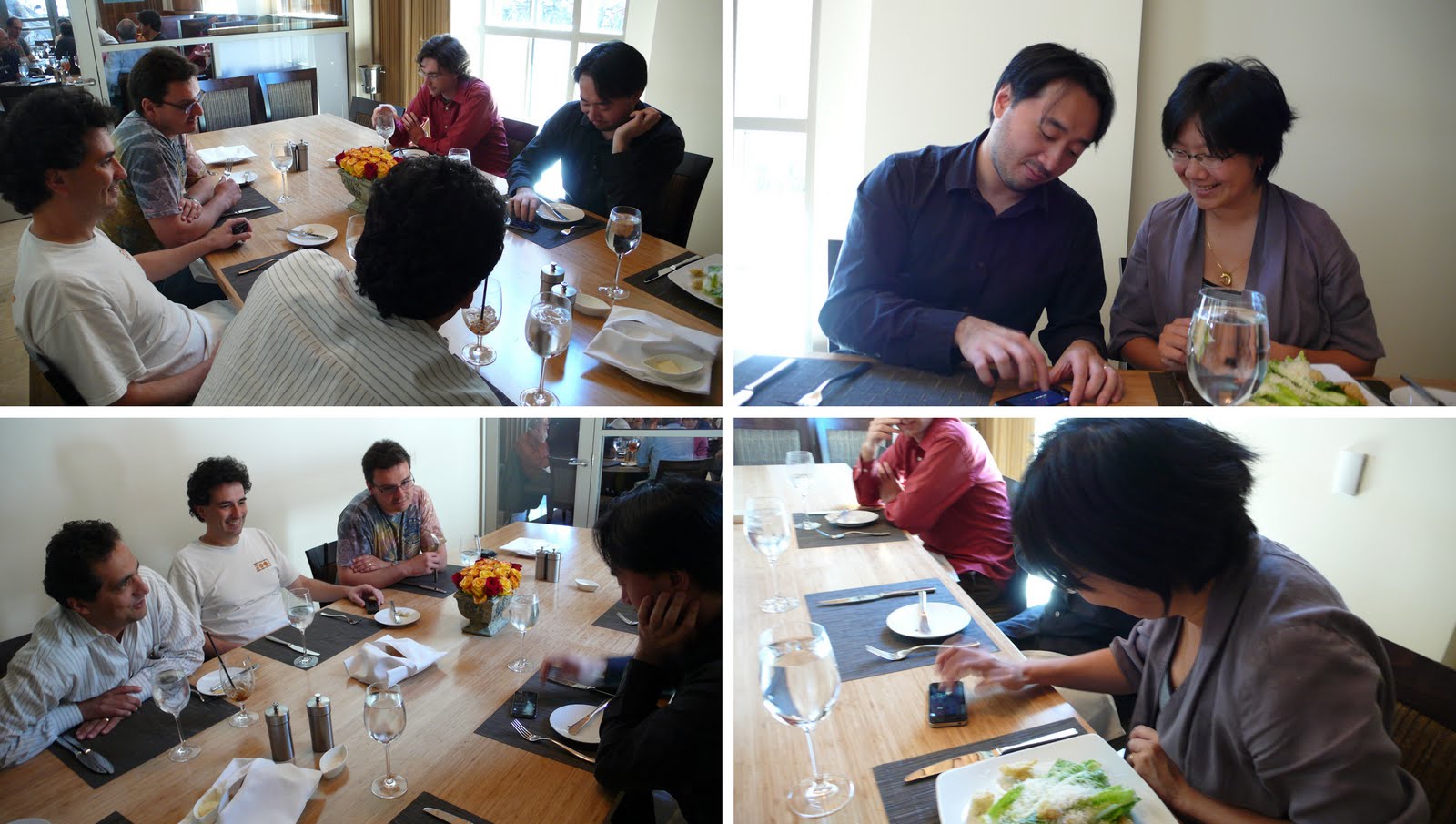
Following the class, we had lunch at Morton Fig, where Ge showed off his Magic Piano app, which is about to be released on the iPhone in two weeks. At Maged Dessouky's request, Ge called in to Smule to have Chariots of Fire reinstated on the playlist so we could play the piece on the Magic Piano.
The activities culminated in a talk by Ge Wang in the Epstein Institute Seminar Series (the ISE PhD seminar), which gave us a glimpse of laptop ensemble concerts orchestrated by Ge, and the many apps created by Smule, including Sonic Lighter, World Stage, Leaf Trombone, Magic Fiddle, and I Am T-Pain.  Ge described how they experimented with giving users a social experience with the development of each app.